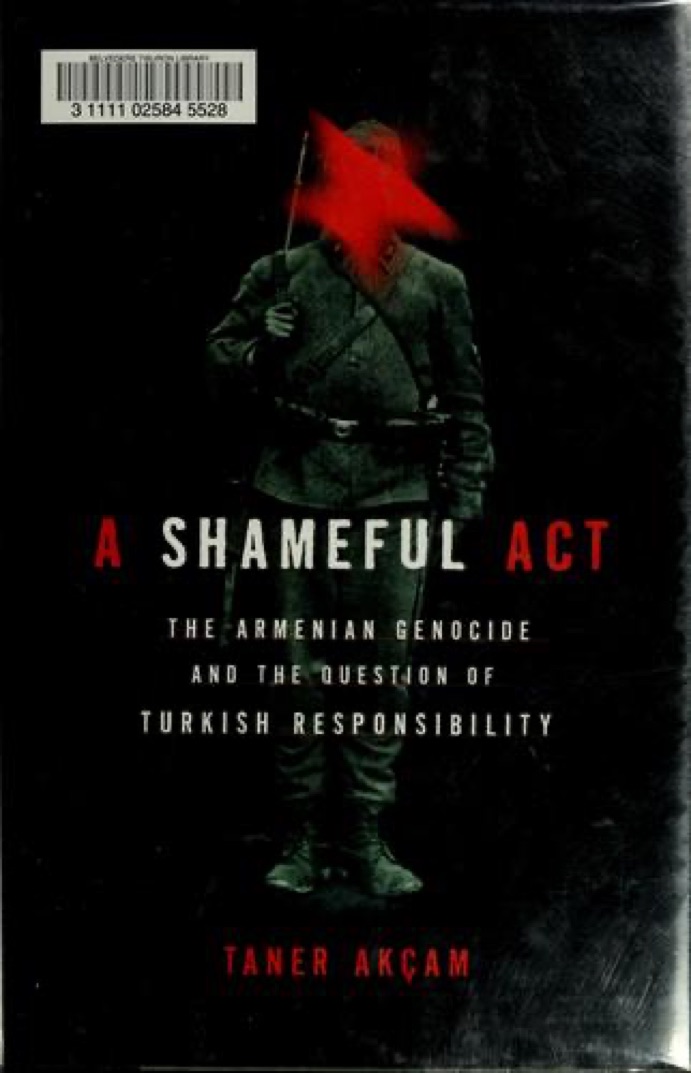
A Shameful Act: The Armenian Genocide and the Question of Turkish Responsibility
Applying the lessons from "A Shameful Act: The Armenian Genocide and the Question of Turkish Responsibility" by Taner Akçam to your life can be a profound exercise in understanding the weight of institutional integrity and the necessity of moral courage in the face of systemic pressure. Here are some ways you might integrate these lessons:
-
Upholding Ethical Standards in Large Organizations: - You must recognize that institutional goals can sometimes drift toward unethical outcomes if not checked by a strong moral compass. Whether in a healthcare system or a venture firm, ensure that your "Stay Humble" mantra includes a willingness to question the status quo when it compromises human dignity.
-
The Danger of Radical Ideological Homogeneity: - In your leadership roles, you should actively cultivate a diversity of thought and background to prevent the kind of groupthink that led to the CUP's radicalization. Historical tragedies often stem from the belief that a single group or idea must dominate at any cost; your role as a serial entrepreneur is to build inclusive ecosystems that thrive on variety rather than exclusion.
-
Acknowledging and Learning from Failure: - Just as states struggle to acknowledge past crimes, individuals and leaders often find it difficult to admit to significant errors. You should practice the habit of "intellectual honesty," where you confront the "shameful acts" or mistakes in your own career or businesses directly, using them as catalysts for growth rather than burying them under a narrative of constant success.
-
The Role of Professional Responsibility: - The book highlights how doctors and lawyers were complicit in the genocide by providing a veneer of legality and scientific justification. In your dual role as an attorney and physician, you must remain vigilant that your professional skills are used strictly to protect and serve, never to provide cover for institutional malpractice or systemic harm.
-
Historical Literacy as a Leadership Tool: - You can deepen your decision-making capabilities by studying the darkest chapters of history to understand the precursors of social and organizational collapse. Being a lifelong learner means more than just acquiring new skills; it means understanding the historical context of the world you are trying to change.
-
Commitment to Truth over Expediency: - Akçam’s work teaches that a foundation built on a lie is inherently unstable. In law, medicine, and business, you must prioritize the pursuit of truth and transparency, even when it is politically or financially inconvenient, to ensure the long-term viability of your ventures.
By integrating these lessons, you will foster a legacy of integrity that transcends professional achievement and contributes to a more just and self-aware society.
What the book covers
"A Shameful Act: The Armenian Genocide and the Question of Turkish Responsibility" by Taner Akçam is a definitive historical investigation into the systematic annihilation of the Armenian population within the Ottoman Empire during World War I. Utilizing a wealth of previously untapped Ottoman state documents, Akçam provides an exhaustive account of how the genocide was planned and executed by the ruling Committee of Union and Progress (CUP). The book challenges decades of state-sponsored denial by demonstrating that the atrocities were not a consequence of civil war or chaos, but a deliberate state policy designed to achieve the ethnic homogenization of Anatolia.
Summary:
-
The Ideological Shift Toward Ethno-Nationalism: - Akçam traces the transformation of the Ottoman Empire from a multi-ethnic imperial structure to a Turkish nationalist state. He explains how the Young Turk revolution and the subsequent rise of the CUP led to a radicalized ideology that viewed the Armenian population as an existential threat to Turkish sovereignty. - This shift necessitated a "cleansing" of Anatolia to create a homogenous heartland. The author argues that the loss of Balkan territories further fueled this desperation, leading the leadership to believe that the empire’s survival depended on the removal of non-Muslim elements.
-
The Special Organization and State-Sposored Violence: - A critical component of the book is the analysis of the "Teskilat-i Mahsusa," or Special Organization. This paramilitary wing of the CUP was specifically tasked with the destruction of Armenian convoys, operating outside the regular military chain of command to maintain a layer of plausible deniability for the central government. - Akçam provides evidence that this organization was staffed by released criminals and directed by high-ranking officials. This highlights the dual-track mechanism of the Ottoman state: official decrees of "relocation" masked the unofficial orders for mass execution.
-
The Mechanics of Genocide and Deportation: - The book details the logistics of the 1915 deportations, showing they were designed as death marches toward the Syrian desert. Akçam examines the legislative frameworks, such as the Tehcir Law, which provided a veneer of legality to the seizure of Armenian property and the forced removal of civilians. - By analyzing local administrative records, the author shows how regional governors were often pressured or replaced if they did not carry out the extermination orders with sufficient zeal. This demonstrates the centralized control exerted by the Istanbul-based leadership.
-
The Istanbul Trials and the Post-War Reckoning: - Following the Ottoman defeat in 1918, a series of domestic courts-martial were held in Istanbul to prosecute the architects of the massacres. Akçam uses the transcripts from these trials to prove that contemporary Turkish officials were well aware of the systematic nature of the crimes. - These trials initially resulted in death sentences for key leaders like Talat Pasha and Enver Pasha. However, as the Turkish nationalist movement led by Mustafa Kemal gained strength, these judicial proceedings were increasingly viewed as concessions to foreign powers, leading to their eventual abandonment.
-
The Continuity of Denial and National Identity: - Akçam explores the psychological and political reasons behind the modern Turkish state’s refusal to acknowledge the genocide. He argues that because many founders of the Turkish Republic were involved in or benefited from the genocide, acknowledging the crime would threaten the foundational myths of the nation. - The book posits that the silence surrounding 1915 is not merely a historical oversight but a structural necessity for a national identity built on the erasure of its Christian minorities. This section emphasizes the moral cost of building a state on unacknowledged foundations.
This work remains a landmark in historical scholarship for its use of the perpetrators' own records to confirm the victim's accounts. By bridging the gap between Turkish archives and Armenian testimony, Akçam forces a confrontation with the complexities of state-sponsored violence and the long-term impact of historical injustice on global politics.