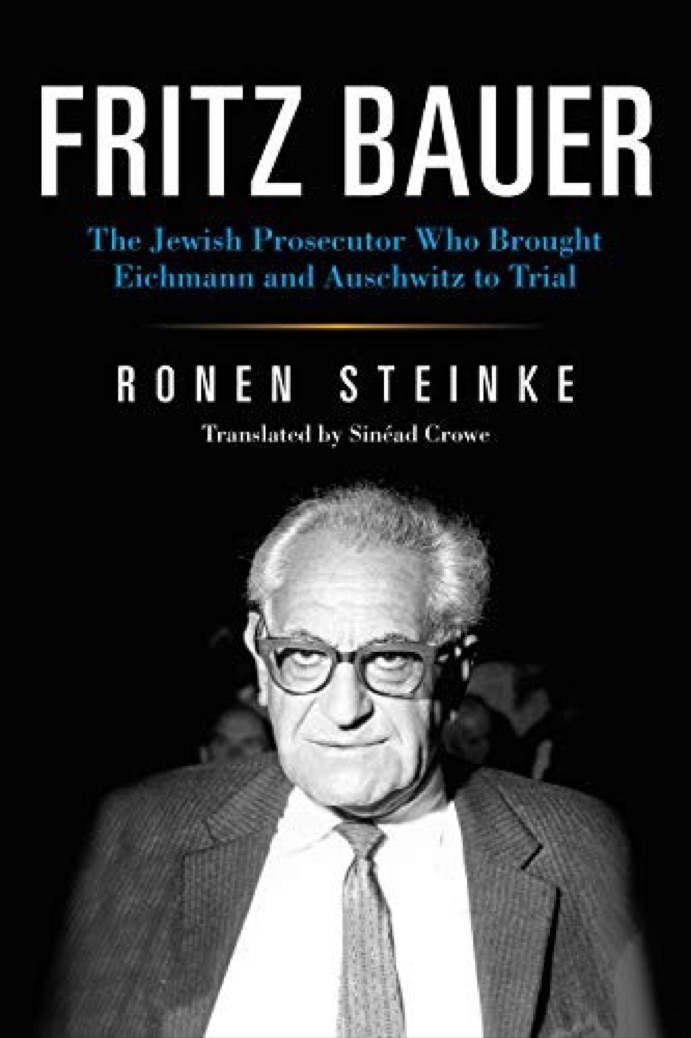
Fritz Bauer: The Jewish Prosecutor Who Brought Eichmann and Auschwitz to Trial
Applying the lessons from "Fritz Bauer: The Jewish Prosecutor Who Brought Eichmann and Auschwitz to Trial" by Ronen Steinke to your life can be a transformative exercise in understanding the moral weight of leadership and the courage required to challenge institutional inertia. Here are some ways you might integrate these lessons:
-
Exercise Principled Non-Conformity: - You must be willing to stand alone when the prevailing culture is headed in the wrong direction. Just as Bauer returned to a hostile environment to demand accountability, you should recognize when your professional or social circles are succumbing to groupthink or ethical shortcuts. True leadership often requires being the "outsider on the inside" who refuses to ignore inconvenient truths for the sake of harmony.
-
Practice Strategic Subversion for the Greater Good: - Bauer’s decision to leak information to the Mossad teaches you that sometimes the formal chain of command is the very thing preventing justice or progress. In business or law, if the existing systems are fundamentally broken or compromised, you must have the courage and the strategic mind to find alternative pathways to achieve a moral objective, even if it puts your own status at risk.
-
Redefine the Duty of Resistance: - In your role as a lawyer, physician, or entrepreneur, you should adopt Bauer’s philosophy that "state of necessity" justifies breaking rank. This means that when you encounter systemic failure—whether it is a hospital policy that harms patients or a corporate practice that exploits users—your highest duty is to the human impact, not the institutional rulebook.
-
Confront the "Ordinary" Failures: - The Frankfurt trials teach you that systemic evil is sustained by the compliance of everyday professionals. You should regularly audit your own organizations to ensure that "just following orders" never becomes an acceptable excuse for poor outcomes. Aim to build a culture where every team member feels a personal, individual responsibility for the ethical output of the collective.
-
Build Resilience Against Isolation: - Challenging the status quo is exhausting and lonely work. Bauer’s life reminds you that to be a transformer of systems, you must develop a thick skin and find internal sources of motivation. Acknowledge that the more significant the change you are trying to implement, the more resistance you will face from those who benefit from the current state of affairs.
-
Value Historical and Root Cause Analysis: - Just as Bauer forced Germany to look at its past to secure its future, you should utilize root cause analysis in medicine and business to confront failures head-on. Do not settle for superficial fixes; look for the underlying historical or cultural reasons for why a system is failing, and have the bravery to name them publicly.
By integrating these lessons, you commit yourself to a life of active integrity rather than passive compliance. Like Fritz Bauer, you can become an architect of a more just and transparent world by refusing to let the convenience of the present bury the responsibilities of the past.
What the book covers
"Fritz Bauer: The Jewish Prosecutor Who Brought Eichmann and Auschwitz to Trial" by Ronen Steinke is a meticulously researched biography that restores a vital figure to his rightful place in history. Steinke chronicles the life of the German-Jewish judge and prosecutor who, after returning from exile following World War II, dedicated his life to purging the West German legal system of its Nazi remnants. The book explores Bauer’s courageous, often solitary struggle to hold perpetrators accountable in a society that preferred to forget its crimes.
Summary:
-
The Exile’s Return: - Steinke opens by detailing Bauer’s early life and his harrowing experience as a young judge arrested by the Gestapo in 1933. After escaping to Denmark and later Sweden, Bauer made the controversial decision to return to post-war Germany, driven by a sense of duty to help rebuild a democratic state. He found a country where the judiciary, police, and civil service were still staffed by men who had served the Third Reich, making his mission as a Social Democratic Jew inherently dangerous and isolating.
-
The Remer Trial and the Right to Resist: - One of Bauer's first major victories was the 1952 trial of Otto Ernst Remer, a former Nazi officer who called the July 20th conspirators (who tried to assassinate Hitler) traitors. Bauer successfully argued that the Nazi state was an "unjust state" (Unrechtsstaat), meaning that resistance against it was a legal and moral duty. This landmark ruling effectively rehabilitated the reputation of the resistance fighters and established a legal framework for challenging authoritarianism.
-
The Secret Hunt for Adolf Eichmann: - The book reveals the shocking extent of Bauer’s clandestine operations, most notably his decision to bypass his own government to provide the Israeli Mossad with the tip that led to Adolf Eichmann’s capture in Argentina. Steinke explains that Bauer committed what could technically be called high treason because he did not trust the West German authorities—many of whom had Nazi ties—not to tip off Eichmann or sabotage the extradition process.
-
The Frankfurt Auschwitz Trials: - Steinke provides a deep dive into Bauer's most significant achievement: the Frankfurt Auschwitz trials of 1963–1965. Unlike the Nuremberg trials, which were led by the Allies, these were German trials of Germans. Bauer insisted on focusing not just on high-level leaders, but on the "ordinary" men—the guards and administrators—who made the machinery of death possible, forcing the German public to confront the specific, gruesome details of the Holocaust.
-
A Systemic Struggle Against Silence: - Throughout the narrative, Steinke highlights the institutional resistance Bauer faced. His colleagues often sabotaged his investigations, and he received constant death threats. The author portrays Bauer as a man living in a state of perpetual "legal guerrilla warfare," using his position as Attorney General of Hesse to fight a system that was designed to protect itself from scrutiny.
-
The Private Burden of a Public Man: - Steinke touches upon Bauer’s personal vulnerabilities, including the fact that he was likely homosexual at a time when Paragraph 175 of the German penal code still criminalized it. This made Bauer susceptible to blackmail and further isolated him from the society he was trying to save. His mysterious death in 1968, found in his bathtub, remains a point of historical contention, though Steinke focuses more on the weight of the exhaustion Bauer carried.
By documenting Bauer’s relentless pursuit of justice, Steinke highlights how a single individual can act as the moral conscience of a nation. The book serves as a powerful reminder that the law is not merely a set of rules, but a tool for human rights and historical reckoning.