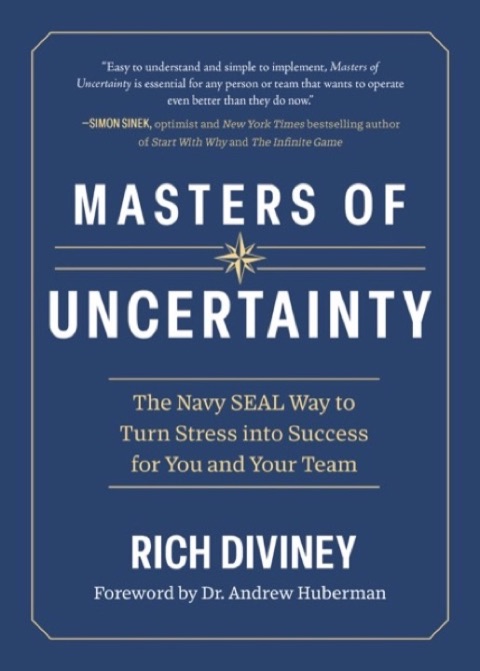
Masters of Uncertainty: The Navy SEAL Way to Turn Stress into Success for You and Your Team
Applying the lessons from "Masters of Uncertainty: The Navy SEAL Way to Turn Stress into Success for You and Your Team" by Rich Diviney to your life can be a transformative experience that aligns perfectly with a pursuit of lifelong learning and high-stakes leadership. Here are some ways you might integrate these lessons:
-
Adopt an Optimal Performance Mindset: - You should move away from the pressure of achieving "peak" performance in every surgery, business deal, or flight. Instead, strive for "optimal" performance by asking yourself: "What is the best I can do right now with the tools and information I have?" This approach fosters resilience and prevents burnout by making excellence sustainable even in suboptimal conditions.
-
Lean Into the Uncertainty Gap: - Whether you are evaluating a new VC investment or navigating a complex legal case, you must recognize that you will never have 100% of the information. You can train yourself to act on 70% certainty, using small, iterative steps to test the environment and adjust your strategy, rather than being paralyzed by the search for perfect data.
-
Audit Your Team for Attributes: - When hiring for your healthcare startups or building a legal team, you should look beyond the resume and technical skills. Focus on identifying core attributes like adaptability, compartmentalization, and teamability, as these are the qualities that will determine whether your team thrives or fractures when a project encounters unexpected turbulence.
-
Master Your Biological Response: - You can utilize Diviney’s physiological regulation techniques, such as box breathing and sensory grounding, during high-pressure moments in the ER or the cockpit. By proactively managing your nervous system, you ensure that your executive functions remains sharp, allowing you to stay "hungry and humble" even when the stakes are at their highest.
-
Empower Through Decentralized Command: - In your leadership roles, you should foster a culture where your team members understand the ultimate goal so clearly that they can act autonomously without waiting for your input. This allows your organizations to be more agile and responsive, as the people closest to the problem are empowered to solve it in the face of uncertainty.
By integrating these lessons, you will cultivate a version of leadership that is not only effective but also profoundly resilient. You will stop viewing the unknown as an obstacle and start seeing it as the domain of the elite, allowing you to lead your teams through any storm with the calm confidence of a master of uncertainty.
What the book covers
"Masters of Uncertainty: The Navy SEAL Way to Turn Stress into Success for You and Your Team" by Rich Diviney is a profound exploration of human performance in environments defined by chaos and unpredictability. Drawing from his twenty years as a Navy SEAL officer and his work with elite organizations, Diviney argues that the ability to navigate the unknown is the ultimate competitive advantage. The book provides a psychological and physiological roadmap for transforming the paralyzing effects of stress into a fuel for optimal performance. By shifting the focus from controlling the environment to mastering one's response to it, Diviney offers a framework that is as applicable to the boardroom as it is to the battlefield.
Summary:
-
The Distinction Between Stress and Uncertainty: - Diviney posits that stress is not an external force but a biological response to the environment, specifically the environment of uncertainty. He explains that while we cannot always control the external situation, we can learn to manage the internal chemical response that uncertainty triggers. - By understanding this distinction, leaders can move away from the futile attempt to eliminate uncertainty and instead focus on building the capacity to operate effectively within it, turning a perceived threat into a manageable challenge.
-
Optimal Performance vs. Peak Performance: - The author critiques the modern obsession with "peak performance," which he describes as a fleeting, unsustainable state that requires ideal conditions. In contrast, "optimal performance" is the ability to do the absolute best one can with the resources available in any given moment, no matter how dire. - This shift allows individuals and teams to maintain high standards and functionality during "bad days" or crises, ensuring that performance does not collapse when the situation deviates from the plan.
-
The Uncertainty Gap and Decision-Making: - Diviney introduces the "Uncertainty Gap," the void between what is known and what is unknown. He argues that masters of uncertainty are those who can close this gap quickly through rapid trial, error, and feedback loops. - The book emphasizes that in high-stakes environments, waiting for perfect information is a recipe for failure; instead, elite performers use "directional" decision-making to move forward and adjust their course as new data becomes available.
-
The Power of Core Attributes: - Building on his previous research, Diviney explains that while skills are learned behaviors, attributes are innate qualities like grit, adaptability, and situational awareness. These attributes are the primary drivers of behavior when a person is pushed into the unknown. - Understanding the attribute profile of oneself and one's team allows a leader to predict how they will react under extreme pressure, facilitating better task allocation and team cohesion during moments of high stress.
-
Physiological Regulation and the Calm Response: - The book provides specific techniques for maintaining biological equilibrium when the "fight or flight" response is triggered. Diviney explores how tools like conscious breathing and cognitive reframing can keep the prefrontal cortex engaged during a crisis. - By mastering these physiological resets, individuals can prevent the "amygdala hijack" that leads to panic, allowing them to maintain the clarity and creativity necessary to solve complex problems in real-time.
-
Building a Resilient Team Culture: - Diviney highlights that a team's ability to master uncertainty depends on a culture of trust and decentralized command. He argues that in rapidly changing environments, the most effective teams are those where every member is empowered to lead and make decisions. - This resilience is built through radical accountability and a shared understanding of the "Commander’s Intent," which provides a North Star for the team even when the specific tactical plan becomes obsolete.
Ultimately, "Masters of Uncertainty" serves as a vital guide for anyone operating in the modern world's volatile landscape. Its significance lies in its ability to translate elite military wisdom into actionable strategies for professional and personal growth, proving that the unknown does not have to be a source of fear, but can instead be a source of strength.