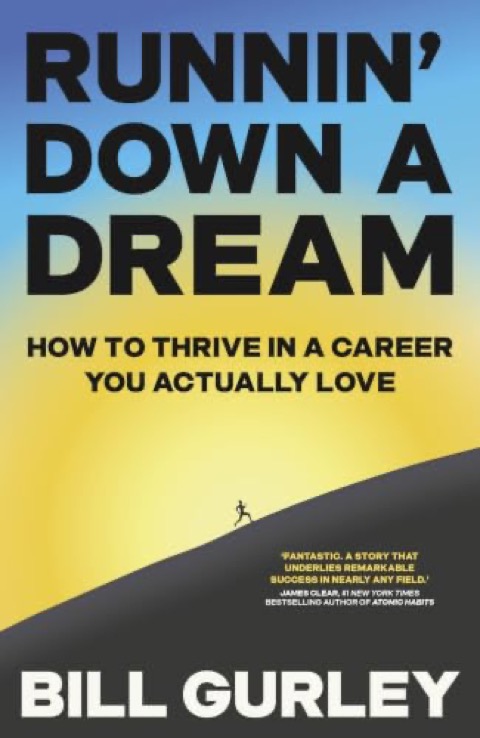
Runnin' Down a Dream: How to Thrive in a Career You Actually Love
Applying the lessons from "Runnin' Down a Dream" by Bill Gurley to your life can be the catalyst for transforming a successful but stagnant career into a lifelong pursuit of excellence and impact. Here are some ways you might integrate these lessons:
-
Audit Your Intellectual Curiosity: - You should identify the topics you find yourself researching when nobody is watching or paying you. In fields like medicine or venture capital, this "unforced interest" is what allows you to maintain a competitive edge and avoid burnout by turning work into a form of high-level play.
-
Commit to Hyper-Specialized Mastery: - Whether you are piloting an aircraft or leading a healthcare startup, you must go beyond general competency to achieve "craftsmanship." This means dedicating specific hours each week to deep-dive into the technical nuances, legal frameworks, or market trends of your industry until your knowledge base is both broad and uniquely deep.
-
Engineer Your Proximity to Excellence: - Evaluate whether you are physically and socially positioned in the "room where it happens." You should proactively place yourself in environments—whether at specific industry conferences or in geographic hubs—where the highest density of experts and innovators in your field reside to maximize your exposure to new ideas.
-
Build a Reciprocal Professional Circle: - Look at your network not as a list of contacts, but as an ecosystem of peers and mentors. You should reach out to those who are five steps ahead of you for guidance while simultaneously investing in the growth of your colleagues, recognizing that their future success will ultimately elevate your own.
-
Step Off the "Safe" Path Regularly: - Challenge the traditional markers of success that may be keeping you on a "conveyor belt." If a new venture or clinical model aligns with your fascination but seems risky to outsiders, you should have the courage to pivot, trusting that your disciplined approach to learning will mitigate the danger of the unknown.
-
Adopt a Legacy of Mentorship: - As a leader, your ultimate impact is measured by the talent you develop. You should formalize your commitment to "giving back" by actively seeking out hungry, humble individuals to mentor, ensuring that the lessons you have learned in law, medicine, and business are passed on to the next generation of entrepreneurs.
By integrating these lessons, you move beyond the limitations of a standard career path and into a realm of professional life where your hunger for knowledge and humble spirit of service create a compounding cycle of success. This approach ensures that you are not just running down a dream, but building a legacy of excellence that inspires others to do the same.
What the book covers
"Runnin' Down a Dream: How to Thrive in a Career You Actually Love" by Bill Gurley is a strategic roadmap designed to help professionals escape the cycle of "career regret" and find deep fulfillment in their work. Drawing from his storied career as a general partner at Benchmark and his observation of industry titans, Gurley argues that professional greatness is rarely an accident of luck or pedigree. Instead, he provides a research-backed framework centered on intentionality and the relentless pursuit of fascination to help readers build a career that feels like a mission rather than a job.
Summary:
-
The Conveyor Belt and Career Regret: - Gurley introduces the concept of the "conveyor belt," a systemic societal pressure that pushes high-achieving individuals toward safe, traditional, and prestigious careers without regard for personal fascination. He cites a study conducted with the Wharton School of Business revealing that nearly 60% of professionals would choose a different path if they could start over, highlighting a global crisis of engagement.
-
Chase Your Curiosity over Passion: - The author suggests replacing the vague advice of "following your passion" with the more actionable pursuit of "fascination." He uses the example of legendary restaurateur Danny Meyer, who abandoned a high-paying sales career and the path to law school because he was obsessively curious about the restaurant industry. Fascination acts as the fuel for the long hours and deep study required to reach the top of any field.
-
Hone Your Craft through Immersion: - Gurley emphasizes that true mastery requires a level of commitment that goes far beyond traditional education. He profiles figures like Tony Fadell and Bob Dylan to show how they immersed themselves in their respective domains—computer hardware and folk music—long before they achieved commercial success. The goal is to develop a depth of knowledge that makes you indispensable and uniquely capable of spotting opportunities others miss.
-
Strategic Mentors and Peer Networks: - Success is a collaborative effort requiring both upward mentorship and horizontal peer support. Gurley details how people like talent agent Lorrie Bartlett and coach Bobby Knight intentionally sought out icons in their fields to learn the "unwritten rules" of success. Simultaneously, he argues that your peers are your future industry leaders, and building strong, authentic relationships with them creates a compounding network effect throughout your career.
-
Go Where the Action Is: - Despite the rise of remote work, Gurley argues that geography and proximity remain vital for career acceleration. He posits that every industry has a "center of gravity"—Silicon Valley for tech, Nashville for country music, or New York for finance—and being physically present in these hubs significantly increases your surface area for "planned happenstance" and high-value serendipity.
-
The Power of Generosity and Giving Back: - The final principle focuses on the transition from student to steward. Gurley argues that once an individual has achieved a level of mastery, they have a responsibility to mentor others and contribute back to the ecosystem that supported their rise. This spirit of service not only fulfills a moral obligation but also reinforces the leader’s position as a respected authority within their professional community.
This book is significant because it demystifies the path to elite success by transforming abstract career advice into a set of repeatable, disciplined actions. By emphasizing that anyone can choose to step off the conveyor belt, Gurley empowers individuals at any stage of their journey to take radical ownership of their professional destiny.