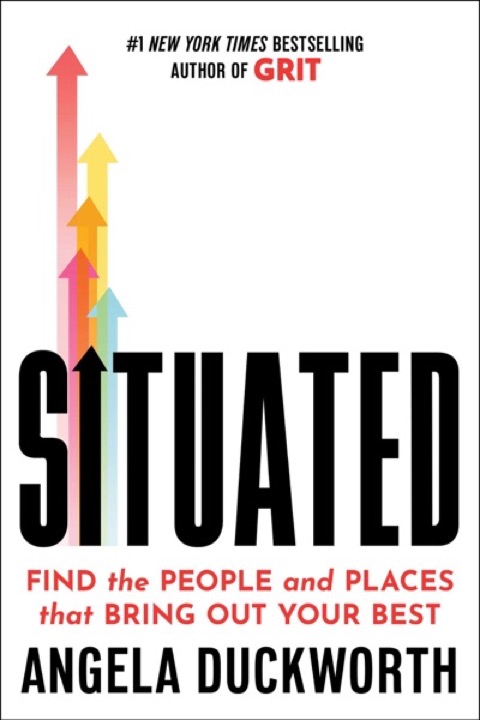
Situated: Find the People and Places That Bring Out Your Best
Applying the lessons from "Situated: Find the People and Places That Bring Out Your Best" by Angela Duckworth to your life can be the catalyst for moving beyond the limits of individual willpower toward a life of engineered excellence. Here are some ways you might integrate these lessons:
- Engineering Entrepreneurial Ecosystems: - In your role as a healthcare entrepreneur and VC leader, recognize that the success of a startup depends as much on the situation you build as the grit of the founders. When evaluating investment opportunities, look at whether the company culture and operational structure are designed to reduce friction and promote high-performance behaviors among the staff.
- Aviation and the Power of Situational Checklists: - Just as a pilot relies on the cockpit environment and standardized procedures to ensure safety, you should view your daily environments as cockpits that need precise calibration. Use environmental cues and choice architecture to ensure that the most critical tasks—whether in medicine or law—are the ones most naturally prompted by your physical surroundings.
- Curating High-Performance Peer Groups: - Reflect on your mantra "Stay Hungry, Stay Humble" by ensuring you are surrounded by people who embody these values. In your journey of lifelong learning, seek out masterminds and executive cohorts that challenge your assumptions and raise your baseline for what is possible, letting social contagion work in your favor.
- Environmental Anchors for Deep Focus: - In legal practice or strategic planning, the complexity of the work requires environments that protect cognitive resources. Apply Duckworth’s principles by creating sprints in specifically designed spaces where the situation is optimized for deep analysis and the exclusion of the rapid-fire interruptions typical of clinical life.
- Situational Leadership in Medicine: - As a medical leader, focus on the scaffolding you provide for your residents and staff. Move beyond encouraging them to be tougher and instead focus on how the hospital or urgent care environment can be restructured to support their mental health and focus through better situational design and streamlined workflows.
By integrating these lessons, you will find that achieving your most ambitious goals becomes less a matter of exhausting your internal reserves and more a matter of skillfully navigating and designing the world around you. This shift toward situational mastery allows for sustained high performance while remaining humble about the external factors that contribute to our shared success.
What the book covers
"Situated: Find the People and Places That Bring Out Your Best" by Angela Duckworth is an insightful examination of how the contexts we choose and inhabit dictate our success more than our internal willpower alone. Following her definitive work on grit, Duckworth shifts the focus from individual character to the "situationist" perspective in psychology, arguing that even the most determined people are products of their environments. The book provides a practical and scientific roadmap for identifying the social and physical spaces that foster excellence, allowing readers to deliberately design a life that supports their highest ambitions.
Summary:
- The Power of the Situation: - Duckworth introduces the concept of situationism, which suggests that human behavior is significantly influenced by external factors rather than just innate personality traits. She argues that while grit is essential, it is far easier to be gritty in an environment that rewards perseverance and removes distractions. - The author explains that we often fall victim to the "fundamental attribution error," where we overemphasize a person's character and underemphasize the power of the situation. By acknowledging that context drives behavior, individuals can stop blaming their lack of discipline and start restructuring their surroundings for better results.
- Social Fields and Peer Influence: - One of the most critical components of a person’s situation is the social circle they navigate daily. Duckworth highlights research showing how habits, emotions, and even performance levels are contagious within social networks, effectively shaping our default behavioral settings. - By consciously curating a social field composed of high-performers and individuals with shared values, a person can leverage the power of peer pressure in a positive way. This social scaffolding acts as a natural guide, making the pursuit of excellence feel like a communal effort rather than a lonely struggle.
- Environmental Engineering and Friction: - The book explores the concept of friction as a tool for behavioral change, noting that minor physical changes in our environment can have outsized impacts on our actions. Duckworth posits that success is often a matter of making good choices convenient and bad choices difficult. - This involves the intentional design of workspaces and homes to trigger specific behaviors, such as placing healthy food in plain sight or removing digital distractions. By reducing the activation energy required to start a positive task, we allow our habits to flourish without exhausting our mental energy.
- Identity and the Physical Space: - Duckworth discusses how physical locations become tethered to specific identities and behaviors over time. Places are not just neutral containers; they are repositories of memory and expectation that can either trigger a professional mindset or a state of relaxation. - The book suggests that situating ourselves in specific environments for specific tasks helps cue the brain for the work at hand. Whether it is a dedicated writing desk or a clinical setting, these spaces serve as environmental anchors that help us transition into the roles required of us.
- Cultural Scaffolding in Organizations: - Beyond the individual, Duckworth applies situational psychology to leadership and institutional design. She argues that great leaders don't just hire talented people; they build cultures that make it easy for talented people to do their best work. - This involves creating norms and structures that provide psychological safety and clear pathways for growth. When the organizational situation is optimized, the entire team’s baseline performance rises, proving that collective success is a byproduct of a well-designed environment.
- The Strategy of Adaptive Situating: - The final sections of the book provide a toolkit for adaptive situating, the proactive process of scanning for and entering environments that align with one's goals. This requires a level of situational intelligence to recognize when a context has become stagnant or harmful. - Duckworth encourages readers to be architects of their own experience by constantly evaluating and adjusting their locations and associations. Instead of trying to change ourselves through brute force, we are encouraged to change our surroundings to naturally become the person we want to be.
This work serves as a necessary companion to the concept of grit, reminding us that resilience is not just a solo act of the will. By focusing on the situation, Duckworth offers a more compassionate and effective path toward self-actualization and sustainable success.