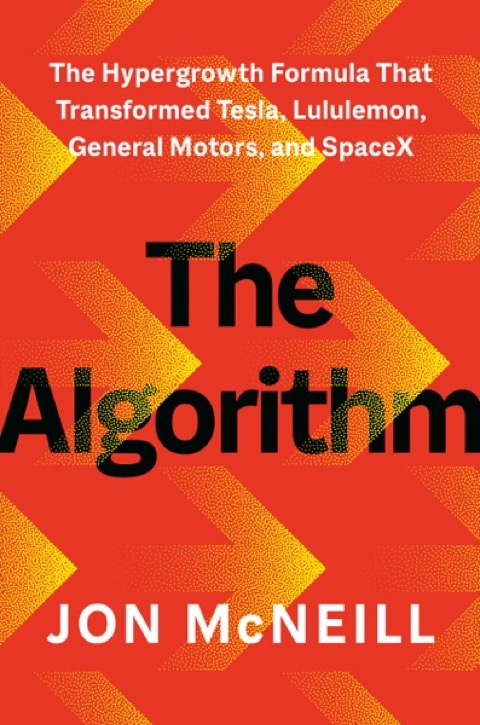
The Algorithm: The Hypergrowth Formula That Transformed Tesla, Lululemon, General Motors, and SpaceX
Applying the lessons from "The Algorithm" by Jon McNeill to your life can be a transformative exercise in stripping away the non-essential to reveal a path for exponential personal and professional scaling. Here are some ways you might integrate these lessons:
-
Question Every Requirement in Your Practice: - Whether in the ER or a VC board meeting, challenge the "why" behind every protocol. You should ask if a specific administrative step or clinical hurdle exists because of a legitimate constraint or simply because it was never deleted; if a requirement doesn't have a name attached to it, it is likely a legacy rule that is slowing your progress.
-
Delete Before You Optimize: - In your entrepreneurial ventures, look for the "parts" of the business model that can be removed entirely. Before you hire more staff or buy more software to fix a bottleneck in telehealth or urgent care, try to eliminate the process causing the friction; you cannot optimize a step that shouldn't exist in the first place.
-
Apply First Principles to Complex Legal and Business Problems: - Use the first-principles thinking championed by McNeill to break down complex legal or financial structures to their basic truths. By ignoring industry "best practices" and focusing on the fundamental physics of the deal or the case, you can find innovative solutions that others miss because they are too busy following the standard playbook.
-
Increase Your Personal Cycle Time: - As a pilot and a learner, you know that speed and accuracy are intertwined. Apply the concept of "cycle time" to your own skill acquisition; by shortening the loop between learning a concept and applying it in a real-world scenario, you accelerate your mastery and increase your output without needing more hours in the day.
-
Simplify Your Communication Strategy: - In leadership, complexity is the enemy of execution. Simplify your directives to your teams at Xcellerant or your clinical staff until they are impossible to misunderstand; a simplified message travels faster and with less distortion, ensuring that everyone is aligned with the core mission.
-
Stay Humble Enough to Re-Evaluate Everything: - The Algorithm requires a total lack of ego regarding past decisions. Be willing to admit when a system you built is now the very thing standing in the way of growth, and have the humility to dismantle it and start from a blank sheet of paper to reach the next level of performance.
By integrating these lessons, you move beyond the role of a manager and become a true architect of hypergrowth. This framework ensures that your diverse pursuits—from medicine to aviation—are not just managed, but are constantly evolving toward a state of radical efficiency and high-impact success.
What the book covers
"The Algorithm: The Hypergrowth Formula That Transformed Tesla, Lululemon, General Motors, and SpaceX" by Jon McNeill is a masterclass in operational excellence and strategic scaling from one of the most successful operators in modern business. Drawing on his experience as the President of Tesla and COO of Lyft, McNeill outlines a specific, repeatable methodology for identifying bottlenecks and accelerating growth in any organization. The book provides a rare, behind-the-scenes look at how the world’s most disruptive companies use a rigorous logical framework to solve seemingly impossible problems.
Summary:
-
The Origin of the Algorithm: - McNeill details his time working alongside Elon Musk at Tesla, where the "Algorithm" was born out of necessity to survive the "production hell" of the Model 3. He explains that the framework is a five-step process designed to eliminate bureaucracy and focus entirely on the physical and logical requirements of the product. - The process begins with questioning every requirement, particularly those that come from a "department" rather than a specific person who can defend them. By forcing leaders to justify every constraint from first principles, the Algorithm strips away decades of inherited corporate waste.
-
The Art of Deletion and Simplification: - A core tenant of the book is the mandate to delete any part or process that is not strictly necessary. McNeill argues that if you aren't adding back at least ten percent of what you deleted, you aren't deleting enough, emphasizing that most corporate bloat occurs because people are afraid to remove redundant systems. - Following deletion, the author moves to simplification. He provides examples from Tesla’s assembly line and General Motors' restructuring to show that simplifying a process before it is optimized or automated is the only way to avoid "automating the mess."
-
Accelerating Cycle Time: - Once a process is simplified, the focus shifts to speed. McNeill discusses how reducing cycle time is the primary lever for increasing capacity without increasing capital expenditure, a lesson he applied to improve service wait times and delivery logistics. - He advocates for a culture of "velocity over perfection," where the organization learns to iterate in real-time. This section highlights how SpaceX used rapid testing cycles to achieve what traditional aerospace companies thought would take decades.
-
Automation as the Final Step: - One of the most common mistakes in business, according to McNeill, is attempting to automate a flawed process. He insists that automation must be the final step of the Algorithm, used only after every requirement has been questioned, every unnecessary part deleted, and the remaining process simplified and accelerated. - He uses the "alien dreadnought" era at Tesla—where over-automation led to production stalls—as a cautionary tale. The lesson is that human flexibility is often superior to rigid automation until a process is perfectly understood.
-
Cross-Industry Application: - The book demonstrates the Algorithm’s versatility by showing its application at Lululemon to streamline retail operations and at General Motors to pivot toward electric vehicle production. McNeill illustrates that these principles are not industry-specific but are instead universal laws of efficiency. - By applying the same rigorous logic to apparel and legacy automotive manufacturing, he proves that hypergrowth is a result of operational discipline rather than just technological innovation.
-
The Leadership Mindset of the Operator: - Finally, McNeill explores the psychological toll and the necessary temperament for leading under the Algorithm. It requires a "stay hungry" attitude where no success is final and every process is subject to constant re-evaluation. - He emphasizes the importance of leaders being on the "front lines"—whether that is the factory floor or the service center—to truly understand the friction points that the Algorithm is designed to solve.
"The Algorithm" is a significant contribution to business literature because it demystifies the "secret sauce" of companies like Tesla and SpaceX. It provides a practical, step-by-step manual for any leader who wishes to transition from incremental improvements to the kind of hypergrowth that reshapes entire industries.