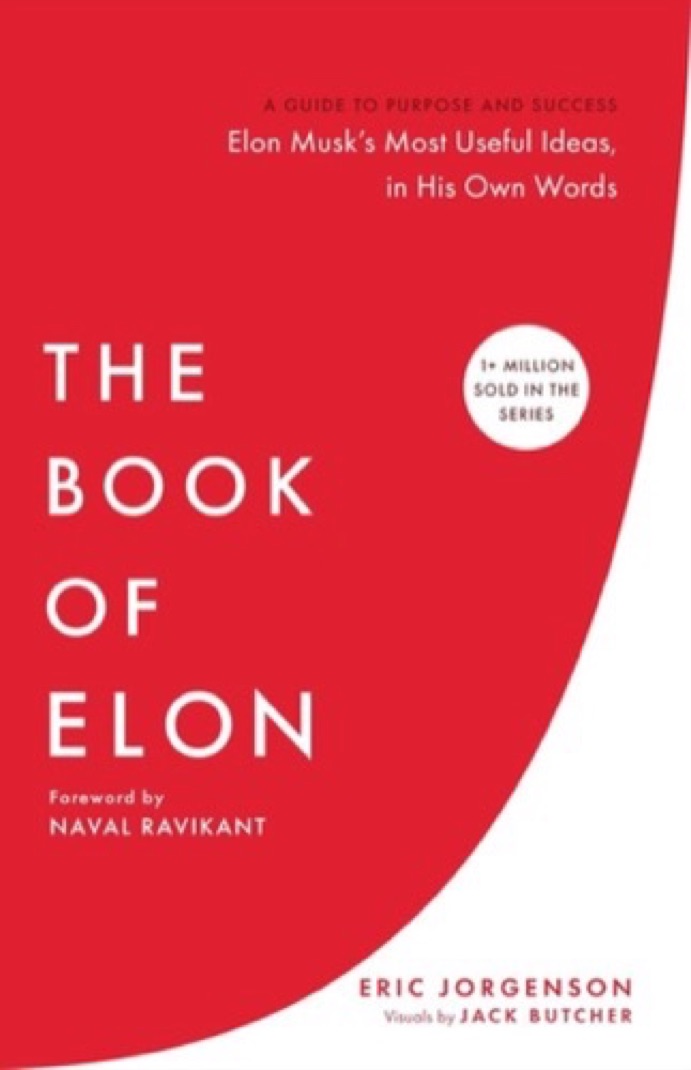
The Book of Elon: A Guide to Purpose and Success
Applying the lessons from "The Book of Elon: A Guide to Purpose and Success" by Eric Jorgenson to your life can be a catalyst for reinventing your approach to complex systems and high-stakes leadership. Here are some ways you might integrate these lessons:
-
Apply First Principles to Healthcare Delivery: - You can challenge the institutional inertia of the medical field by stripping healthcare problems down to their primary components: the patient, the provider, and the outcome. Before accepting a standard administrative hurdle, ask if it is a law of physics or simply a legacy convention that can be engineered away to improve efficiency, much like you did with the urgent care model.
-
Audit Your Professional Workflows with the Algorithm: - Whether in your law practice or your VC firm, use Musk’s five-step process to ruthlessly delete redundant steps. Before you look for new software to automate your investment vetting or legal filings, first ensure you have deleted every unnecessary requirement and simplified the core process to its absolute essence.
-
Calibrate Risk with an Aviator’s Mindset: - Use your experience as a pilot to bridge Musk's engineering rigor with your entrepreneurial ventures. Treat a new healthcare startup at Xcellerant Ventures like a flight plan; ensure the "fundamentals" of the business model are aerodynamically sound before you commit the resources to take off, focusing on the technical truth rather than the market hype.
-
Anchor Your Teams in a "North Star" Mission: - In your leadership roles, elevate the mission beyond quarterly returns to focus on transformative impact. By framing your telehealth or tribal health initiatives as essential components of a larger humanitarian goal, you will attract and retain the type of "mission-driven" talent that thrives under pressure and seeks out difficult challenges.
-
Cultivate a High Tolerance for Productive Failure: - As a lifelong learner, you should view your setbacks as data points in a rapid iteration cycle. Don’t fear the public failure of a new project; instead, embrace the "Starship" philosophy of testing to failure early so that you can refine your next "launch" in medicine or business with greater precision.
-
Balance Hunger with Engineering Rigor: - To live your mantra of "Stay Hungry," adopt Musk’s intensity but ground it in the structural discipline of an engineer. Use your MBA and legal training to create the frameworks that allow your "hunger" for innovation to be funneled into repeatable, scalable successes rather than scattered efforts.
By integrating these lessons, you will refine your ability to lead across diverse sectors with the technical precision of an engineer and the visionary courage of a pioneer, ensuring that your contributions to medicine and entrepreneurship continue to push the boundaries of what is considered possible.
What the book covers
"The Book of Elon: A Guide to Purpose and Success" by Eric Jorgenson is a meticulously curated synthesis of the strategies, mental models, and philosophies that have defined Elon Musk’s career. Jorgenson, known for distilling the wisdom of modern icons, organizes Musk’s disparate interviews, tweets, and shareholder letters into a cohesive blueprint for high-impact innovation. The book serves as both a philosophical guide and a practical manual for those looking to solve humanity's most complex problems through engineering, physics, and sheer force of will.
Summary:
-
The Core of First Principles Thinking: - Jorgenson emphasizes Musk’s reliance on first principles—the practice of breaking a problem down to its fundamental physical truths rather than reasoning by analogy. This approach allows an innovator to see what is physically possible regardless of industry tradition or current market costs, providing the foundation for Musk's disruptions in aerospace and automotive manufacturing.
-
The Five-Step Design and Manufacturing Algorithm: - The book details a rigorous protocol used at Tesla and SpaceX: make requirements less dumb, delete unnecessary parts, simplify or optimize, accelerate cycle time, and then automate. Jorgenson highlights that the most common mistake is automating a process that should have been deleted entirely, illustrating Musk's obsession with efficiency and the removal of bureaucratic "clutter."
-
Risk Mitigation through Deep Technical Understanding: - Rather than viewing risk as a gamble, the book argues that Musk views it as a function of technical knowledge. By understanding the underlying physics of a rocket or a battery better than anyone else, an entrepreneur can take "calculated" risks that appear reckless to outsiders but are actually grounded in empirical reality and rigorous testing.
-
Mission-Driven Leadership and Talent Acquisition: - Jorgenson explores how a grand, existential mission—such as making life multi-planetary—acts as a powerful filter for talent. By setting an impossibly high bar and a clear, noble purpose, Musk attracts individuals who are motivated by the challenge itself, creating a culture of high intensity that can sustain progress through extreme adversity.
-
The Value of Rapid Iterative Loops: - A significant portion of the book is dedicated to the importance of moving fast and breaking things. Jorgenson explains that Musk prefers a visible failure in a prototype over a theoretical delay in a design phase, as real-world data from a failed launch provides more actionable insight than a thousand simulations.
-
Resilience and the Tolerance for Pain: - The narrative concludes with an examination of the personal grit required to manage multiple world-changing companies simultaneously. Jorgenson posits that Musk’s success is inextricably linked to his high threshold for psychological and professional pain, suggesting that true success on a global scale requires a level of obsession that borders on the unreasonable.
This book is significant because it provides a structured intellectual framework for understanding one of the most polarizing and influential figures of the 21st century. By focusing on Musk’s methodologies rather than his personality, Jorgenson offers readers a scalable set of tools for tackling the "impossible" in any field of endeavor.