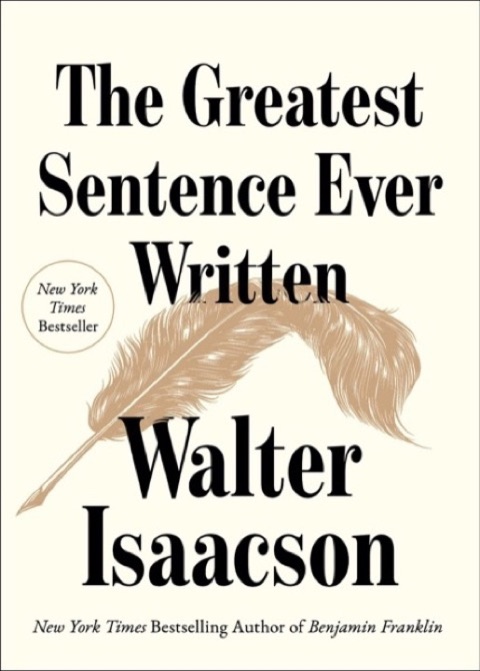
The Greatest Sentence Ever Written
Applying the lessons from "The Greatest Sentence Ever Written" by Walter Isaacson to your life can be a transformative exercise in refining your communication and leadership style to achieve maximum impact. Here are some ways you might integrate these lessons:
-
The Weight of Precision: - In your roles as a physician and attorney, you understand that a single word can alter the trajectory of a diagnosis or a legal contract. You should treat your organizational mission statements and personal communications with the same editorial rigor Franklin applied, ensuring that your "truths" are articulated with absolute clarity and lack of ambiguity.
-
Seeking the "Self-Evident" in Business: - When evaluating potential investments at Xcellerant Ventures, look for business models and value propositions that are "self-evident." If a startup's purpose requires a leap of faith rather than a foundation of rational, observable logic, it may lack the foundational strength required to weather market volatility.
-
The Value of the Intellectual Editor: - Even as a serial entrepreneur and seasoned leader, you must remain "humble" enough to invite rigorous editing of your ideas. Surround yourself with a personal "Committee of Five"—trusted advisors who have the intellectual courage to strike out your "sacred" assumptions and replace them with more effective, rational alternatives.
-
Grounding Leadership in Rationality: - Whether leading a medical team or a flight crew, focus on building consensus around rational axioms rather than personal authority. By rooting your leadership decisions in truths that are evident to all stakeholders, you create a culture of transparency and shared purpose that transcends individual egos.
-
Distilling Complexity into Simplicity: - As an author and lifelong learner, strive for the elegant simplicity found in Jefferson and Franklin's collaboration. Your goal should be to take the complex bureaucracies of healthcare or law and distill them into core principles that are so simple and powerful they become undeniable to your audience.
By integrating these lessons, you can master the art of high-stakes communication, ensuring that your vision for healthcare and entrepreneurship is not just heard, but is perceived as an immutable and self-evident truth.
What the book covers
"The Greatest Sentence Ever Written" by Walter Isaacson is a masterful historical examination of a single, transformative moment in the drafting of the American Declaration of Independence. Isaacson explores the intellectual alchemy that occurred in June 1776 when Thomas Jefferson submitted his rough draft to Benjamin Franklin for review. The book serves as a deep dive into how a subtle linguistic shift—the change of just a few words—reoriented the philosophical foundation of the United States from a theological basis to one grounded in the Enlightenment's scientific rationality.
Summary:
-
The Drafting of a Vision: - Thomas Jefferson, sequestered in a Philadelphia boarding house, was tasked by the Continental Congress to articulate the reasons for the colonies' separation from Britain. Isaacson describes Jefferson not as a lone genius creating in a vacuum, but as a meticulous stylist attempting to synthesize the "American mind" into a coherent political philosophy.
-
The Original Manuscript: - In his initial draft, Jefferson wrote: "We hold these truths to be sacred and undeniable." Isaacson highlights how this phrasing rooted the concept of human equality in a religious and theological context, implying that the rights of man were granted by a divine creator and understood through the lens of faith.
-
Franklin’s Editorial Intervention: - When Benjamin Franklin reviewed the draft, he famously crossed out "sacred and undeniable" and replaced it with "self-evident." Isaacson details how Franklin, ever the scientist and pragmatist, sought to move the argument away from the realm of religious dogma and into the realm of observable, scientific logic.
-
The Influence of the Enlightenment: - The book explores how Franklin’s edit was heavily influenced by the Newtonian physics and the empiricism of the era. By using the term "self-evident," the founders were adopting the language of mathematics and axioms, suggesting that human equality was a rational truth that could be deduced by any thinking person, regardless of their religious affiliation.
-
The Power of Collaborative Leadership: - Isaacson examines the dynamic within the "Committee of Five," which included Jefferson, Franklin, and John Adams. He argues that the friction between these diverse personalities was essential to the document's success, demonstrating that even the most profound individual contributions are improved through rigorous peer review and collaborative refinement.
-
A Lasting Moral Authority: - The final section of the book traces the global and temporal impact of this specific sentence. Isaacson argues that by making equality a "self-evident" truth, the founders created a standard that future generations—including abolitionists and civil rights leaders—could use to hold the nation accountable to its own logical foundations.
As a concise yet profound study of historical prose, the book highlights the immense weight that language carries in shaping the identity of a nation. It serves as a reminder that the progress of civilization often hinges on the clarity and precision of our shared values.