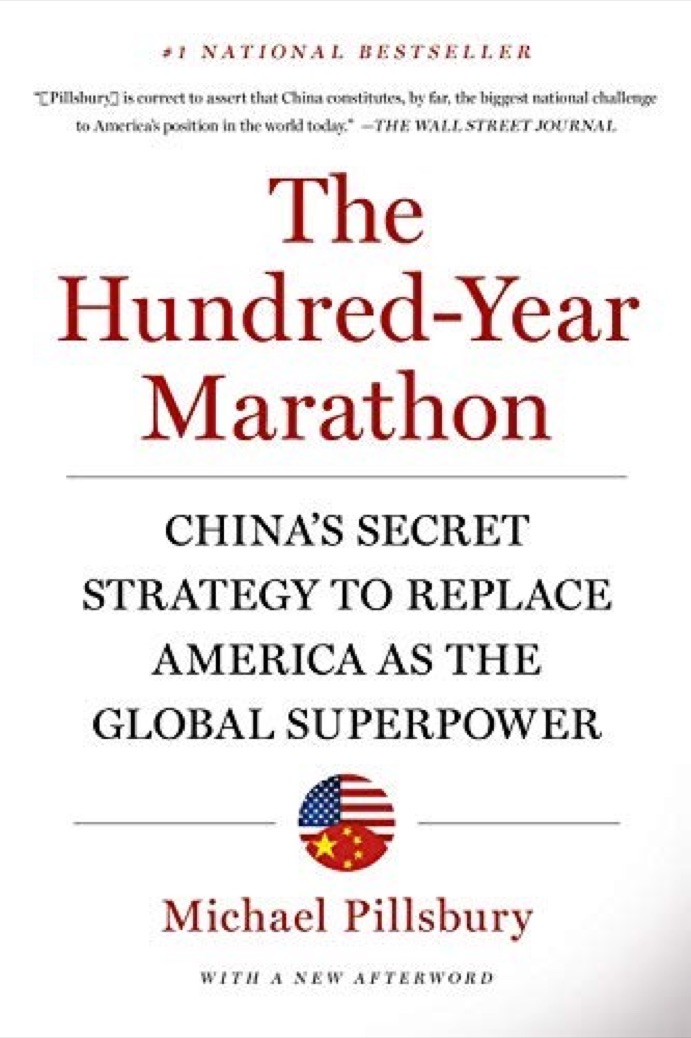
The Hundred-Year Marathon: China's Secret Strategy to Replace America as the Global Superpower
Applying the lessons from "The Hundred-Year Marathon: China's Secret Strategy to Replace America as the Global Superpower" by Michael Pillsbury to your life can be a transformative exercise in long-term strategic thinking and critical situational awareness. Here are some ways you might integrate these lessons:
-
Embrace the Long Game: - In your roles as a healthcare entrepreneur and venture capitalist, you should shift your focus from quarterly gains to multi-decade horizons. Just as the marathon strategy prioritizes the year 2049, you must evaluate your ventures based on their ability to sustain competitive advantages over a lifetime rather than seeking a quick exit that might compromise your long-term impact.
-
Master the Art of Strategic Momentum: - Whether in the cockpit or the boardroom, avoid the temptation to rush into decisions based on immediate pressure. Understanding the concept of shi allows you to wait for the right alignment of circumstances, ensuring that your actions in business or medicine carry the maximum momentum and require the least amount of wasted energy.
-
Question Prevailing Narratives: - As a lifelong learner and attorney, you understand that the "obvious" story is often a construction. You should apply a high level of skepticism to consensus views in business, looking for the underlying motivations of competitors or partners who may be presenting a cooperative front while pursuing divergent goals.
-
Prioritize Defensive Innovation: - Given your history of founding and scaling companies like NextCare and MeMD, you must be vigilant about protecting your intellectual property. In an era of asymmetric competition, assume that your most valuable assets—be they data, processes, or proprietary technologies—are targets, and build security into the foundation of your organizational culture.
-
Synthesize Multi-Disciplinary Intelligence: - Pillsbury’s success came from looking beyond standard intelligence and studying ancient history; similarly, your diverse background in medicine, law, and business is your greatest asset. You should continue to synthesize lessons across these fields to spot "weak signals" of change that others, siloed in a single discipline, will inevitably miss.
-
Maintain Intellectual Humility: - The mantra "Stay Humble" is critical here; the U.S. failed because of the hubris of thinking it could "reform" a rival. You must remain open to the possibility that your competitors are operating under a completely different set of rules or cultural logic, requiring you to constantly re-verify your assumptions.
By integrating these lessons, you will develop the mental fortitude and strategic depth necessary to navigate an increasingly complex global and professional landscape. By balancing your inherent hunger for growth with a humble acknowledgement of potential blind spots, you can ensure that your various professional marathons lead to lasting, sustainable success.
What the book covers
"The Hundred-Year Marathon: China's Secret Strategy to Replace America as the Global Superpower" by Michael Pillsbury is a seminal work on geopolitics that exposes the long-term grand strategy of the Chinese Communist Party. Drawing on his decades of experience as a high-level government official and intelligence analyst, Pillsbury argues that China has been engaged in a systematic effort to surpass the United States as the world's leading superpower by its centenary in 2049. The book challenges the prevailing Western view that China is evolving into a responsible stakeholder in the liberal international order, revealing instead a strategy rooted in ancient statecraft and deception.
Summary:
-
The Origins of the Marathon: - Pillsbury traces the roots of China’s strategy to the founding of the People's Republic in 1949. He argues that Chinese leaders have followed a consistent, multi-generational plan to reclaim China's historical position as the global hegemon by extracting technology, capital, and expertise from the United States while appearing non-threatening.
-
The Philosophy of Shi: - The book explores the ancient Chinese concept of shi, which emphasizes exploiting the momentum of events to achieve victory with minimal effort. By positioning themselves as a weak, developing nation, Chinese leaders induced American policymakers to provide significant aid, which was then used to undermine American dominance from within.
-
The Five Deceptions: - Pillsbury details how China has systematically deceived the West through five specific myths: that engagement brings democracy, that China is on a path to a market economy, that China wants to be a responsible stakeholder, that China is a fragile power, and that Chinese hawks are a minority. These narratives were intentionally crafted to lull the U.S. into a false sense of security.
-
Economic Warfare and Cyber Espionage: - The author describes a state-sponsored system of intellectual property theft and cyber warfare aimed at hollowing out the American industrial base. He highlights how State-Owned Enterprises (SOEs) operate not as market actors, but as arms of the government designed to dominate global supply chains and achieve technological parity through unfair trade practices.
-
The Warring States Influence: - A central argument is that American intelligence failed because it ignored the influence of the "Warring States" period on Chinese strategic thinking. While Western analysts projected their own values onto China, the CCP viewed international relations as a zero-sum game where the ultimate goal is the total displacement of the rival superpower.
-
The Final Phase toward 2049: - As the marathon enters its final decades, China is becoming increasingly assertive in its territorial claims and its efforts to reshape international institutions. Pillsbury warns that the goal is to reach a tipping point where China can openly challenge and replace the U.S.-led order with one centered on Beijing's authoritarian values.
This book serves as a sobering wake-up call for policymakers and citizens alike. It demands a fundamental reassessment of Western engagement with China and suggests that unless the U.S. develops a comprehensive counter-strategy, it may find itself relegated to a secondary role in a world defined by Chinese interests.