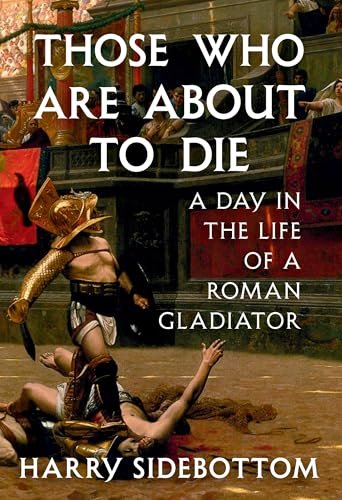
Those Who Are About to Die: A Day in the Life of a Roman Gladiator
Applying the lessons from "Those Who Are About to Die: A Day in the Life of a Roman Gladiator" by Harry Sidebottom to your life can be an exercise in understanding high-stakes performance and the infrastructure of excellence. Here are some ways you might integrate these lessons:
- Mastery Under Mortal Pressure: - In medicine and aviation, much like the arena, performance must be precise despite high stakes. You can cultivate a "gladiator’s discipline" by training your responses to become instinctive, ensuring that when the pressure of an emergency department crisis or a cockpit malfunction peaks, your execution remains flawless.
- The Logistics of Large-Scale Vision: - The Roman games were a miracle of supply chain management and operations. As an entrepreneur, you can appreciate the immense coordination required to deliver a complex service; success often lies in the "unseen" infrastructure and the rigorous preparation that happens long before the public-facing spectacle begins.
- Navigating Public Perception and Status: - The concept of infamia reminds you that external status is often detached from internal character. In leadership and law, you should focus on your "inner scorecard" and professional integrity rather than the fickle fluctuations of public opinion or the social standing assigned to your role.
- The Importance of Specialized Roles: - Just as the arena paired different combat styles to create balance and interest, a successful venture capital firm or medical practice requires a mix of specialized talents. You should identify the unique "equipment" and "style" of each team member to ensure the organization is balanced against diverse market challenges.
- Understanding Stakeholder Psychology: - The Roman editor had to balance the desires of the populace with the needs of the state. In your ventures, you must manage diverse stakeholders—investors, employees, and customers—recognizing that keeping your "audience" engaged requires a deep understanding of their underlying psychology and expectations.
- Resilience in the Face of High Attrition: - The gladiator’s life was defined by the constant presence of risk and the necessity of resilience. In the "Stay Hungry, Stay Humble" philosophy, this translates to accepting the risks of failure in entrepreneurship with a stoic resolve, focusing on the quality of the effort and the commitment to the craft.
By integrating these lessons, you can sharpen your approach to leadership and high-stakes decision-making, ensuring that you remain disciplined in the "arena" of modern business and medicine. Understanding the intersection of technical skill, public expectation, and operational excellence allows you to build organizations that are as resilient as they are impactful.
What the book covers
"Those Who Are About to Die: A Day in the Life of a Roman Gladiator" by Harry Sidebottom is a meticulous historical reconstruction that immerses the reader in the visceral world of the Roman amphitheater. Through a "day in the life" narrative structure, Sidebottom blends deep scholarly research with evocative storytelling to detail the spectacles of the arena from sunrise to sunset. The book explores not just the combat itself, but the socio-political, economic, and psychological frameworks that supported one of history's most brutal forms of entertainment.
Summary:
- The Morning Venationes: - Sidebottom begins with the wild beast hunts, highlighting the logistical marvel required to transport exotic predators from the edges of the empire to Rome. This section illustrates how the games served as a demonstration of Roman dominion over the natural world and foreign lands. - The author explains the roles of the bestiarii, who were often seen as lower-tier performers but required immense bravery and specialized skill to handle lions, leopards, and bulls in front of a stadium of thousands.
- The Midday Executions: - Often overlooked in popular media, the noon interval featured the execution of criminals and prisoners of war through various theatrical and gruesome means. Sidebottom analyzes the transition from simple justice to public spectacle, where the crowd’s participation transformed state-sanctioned violence into a shared social ritual of order.
- The Gladiatorial Hierarchy and Training: - The book explores the rigorous life within the ludus (training school), where men from various backgrounds—slaves, criminals, and volunteers—were forged into specialized combatants. This technical training emphasizes the discipline and professionalism required to perform under the ultimate life-or-death pressure.
- The Archetypes of the Arena: - Sidebottom details the distinct roles of the secutor, retiarius, and thraex, explaining the tactical "rock-paper-scissors" balance of their equipment. This diversity ensured that matches remained unpredictable and engaging for a highly discerning Roman audience that valued technique over mere brawling.
- The Paradox of Infamia: - A central theme is the gladiator's social status; they were legally infames—among the lowest dregs of society—yet they achieved a level of celebrity akin to modern professional athletes. This duality highlights the complex Roman relationship with masculinity, skill, and disposable human life.
- The Economy of the Arena: - The narrative dives into the business side of the games, involving the lanistae who bought and sold human lives and the editores who funded the spectacles for political gain. Sidebottom shows that the games were as much a financial calculation as they were a physical contest.
- The Sensory Experience of the Colosseum: - The author recreates the atmosphere of the amphitheater, from the smell of saffron used to mask the scent of blood to the specific etiquette of mercy or death directed by the crowd and the emperor. This provides a three-dimensional view of how the Roman public experienced the event.
This work serves as a sobering examination of human nature and the societal structures that normalize violence for the sake of political stability. By humanizing the combatants and detailing their technical mastery, Sidebottom highlights the tension between individual agency and systemic cruelty in the ancient world.