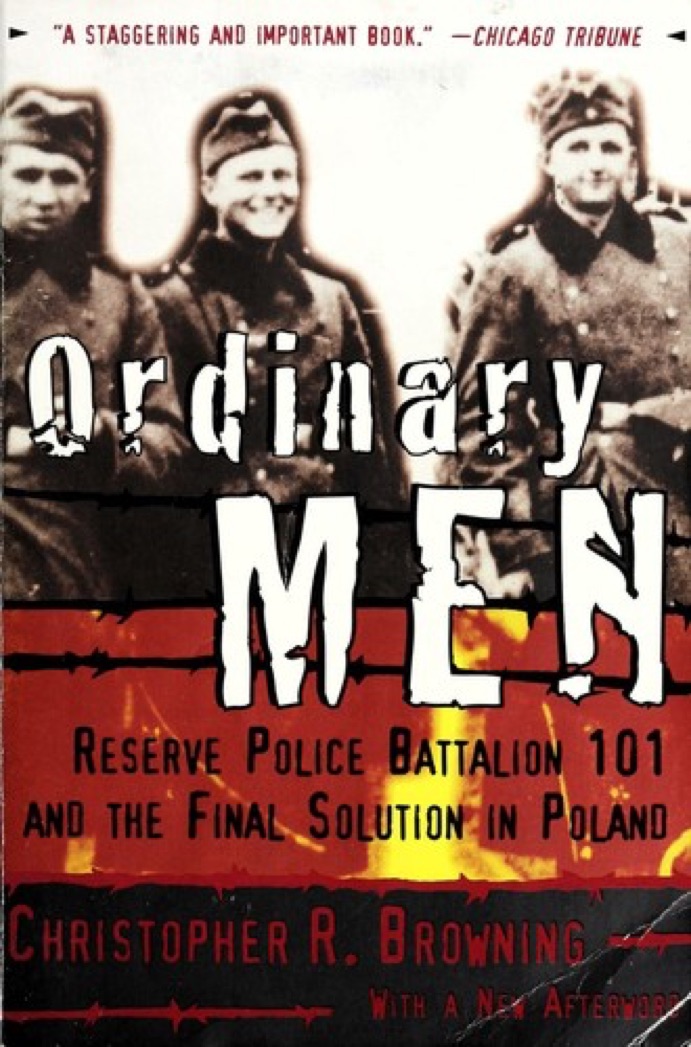
Ordinary Men: Reserve Police Battalion 101 and the Final Solution in Poland
Applying the lessons from "Ordinary Men: Reserve Police Battalion 101 and the Final Solution in Poland" by Christopher R. Browning to your life can be a sobering yet vital exercise in ethical vigilance and leadership. Here are some ways you might integrate these lessons:
-
Cultivate Ethical Triage in Leadership: - In high-stakes environments like the ER or a fast-scaling startup, the pressure to move quickly can lead to a dangerous "groupthink" where dissent is viewed as an obstacle. You must actively build a culture where your team feels safe questioning the status quo, ensuring that efficiency never comes at the cost of your organization’s moral compass.
-
The Moral Weight of Your "In-Group": - Recognize that your social and professional circles exert a silent but powerful pressure on your decision-making. Whether in law or venture capital, you must be hyper-aware of the desire to "fit in" or not let your peers down, as this instinct can lead you to support policies or actions that conflict with your personal values.
-
Resist Professional Dehumanization: - In medicine and law, the volume of work can tempt you to treat patients or clients as mere numbers or cases. You must consciously work to preserve the humanity of those you serve; the moment you allow yourself to see others as less than human to cope with stress, you begin a dangerous slide toward ethical desensitization.
-
Exercise the "Józefów Choice": - Major Trapp’s offer proves that even in rigid systems, there is often a choice. In your own life, look for the moments where you can provide an "out" for others who may be struggling with an ethical dilemma, and have the courage to take that out yourself when the path ahead is morally compromised.
-
Maintain Situational Awareness of Culture: - Just as a pilot monitors their instruments to avoid a stall, you must monitor the "moral instruments" of your environment. Be vigilant for the slow creep of desensitization within your companies, where small ethical compromises eventually pave the way for systemic failure.
-
The Discipline of Staying Humble and Vigilant: - The most terrifying lesson of this book is that these were "ordinary" people. You must discard the ego-driven belief that you are inherently immune to social pressure. True character is not a fixed state but a continuous practice of questioning authority and your own motivations every single day.
By integrating these lessons, you develop a framework for principled leadership that protects both your integrity and the well-being of those under your care. The goal is to ensure that under pressure, you remain the exception to the rule of conformity, choosing the difficult right over the easy wrong.
What the book covers
"Ordinary Men: Reserve Police Battalion 101 and the Final Solution in Poland" by Christopher R. Browning is a harrowing and foundational work of Holocaust history that investigates how average citizens become mass murderers. By focusing on a single unit of German Order Police, Browning shifts the historical gaze away from high-level Nazi ideologues to the rank-and-file individuals who carried out the physical work of genocide. The book utilizes post-war judicial records to reconstruct the unit's actions, offering a terrifying glimpse into the psychological and sociological mechanisms that facilitate atrocities.
Summary:
-
The Profile of Reserve Police Battalion 101: - The members of this battalion were not young, indoctrinated SS fanatics; they were middle-aged, working-class men from Hamburg who were considered too old for regular military service. Most had been socialized in the pre-Nazi era, making them unlikely candidates for the virulent ideological commitment typically associated with the perpetrators of the Holocaust.
-
The Massacre at Józefów: - In July 1942, the battalion was ordered to round up and execute 1,500 Jews in the Polish village of Józefów. The unit's commander, Major Wilhelm Trapp, gave an unprecedented offer to his men: those who did not feel up to the task could step out and perform other duties without fear of punishment. Only a tiny fraction of the men took the offer initially.
-
The Role of Peer Pressure and Conformity: - Browning argues that the primary motivator for the killing was not deep-seated anti-Semitism, but a powerful urge to conform. Most men chose to participate in the slaughter because they did not want to appear weak or "cowardly" in front of their comrades, or leave the "dirty work" to their friends.
-
The Habituation of Violence: - After the initial trauma of the first massacre, which many men found physically and emotionally repulsive, the battalion's resistance to killing rapidly eroded. Over time, the mass shootings became a routine "job," and the men became increasingly efficient and desensitized to the horror they were inflicting.
-
Dehumanization and Psychological Distancing: - The book explores how the victims were reduced to abstract targets through propaganda and the administrative nature of the "Final Solution." As the battalion moved from mass shootings to deporting Jews to death camps, the physical distance between the killers and their victims provided a psychological buffer that made the genocide easier to stomach.
-
The Milgram and Zimbardo Connections: - Browning applies modern psychological experiments—specifically Stanley Milgram’s work on obedience to authority and Philip Zimbardo’s Stanford Prison Experiment—to explain the battalion's behavior. He illustrates how individuals defer their moral agency to superiors and how easily they adopt brutal personas when placed in specific institutional roles.
-
The Path of Least Resistance: - A central theme of the work is the lack of coercion; the men were rarely punished for refusing to kill, yet they continued to do so. This highlights a terrifying aspect of human nature: the tendency to follow orders and group norms even when they violate one's most basic moral foundations.
-
Post-War Accountability and Denial: - The final sections of the book cover the post-war trials, where many of the men claimed they were merely following orders or had no choice. Browning dismantles these defenses, showing that the opportunity to act ethically existed, but was consistently sacrificed for the sake of social cohesion.
Browning’s work remains a vital warning about the fragility of human morality. It suggests that the capacity for extreme cruelty is not limited to a specific culture or ideology, but is a latent potential within almost any human being subjected to the right (or wrong) social pressures.