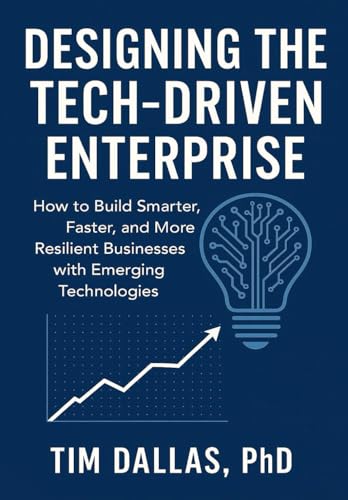
Designing the Tech-Driven Enterprise: How to Build Smarter, Faster, and More Resilient Businesses with Emerging Technologies
Applying the lessons from "Designing the Tech-Driven Enterprise: How to Build Smarter, Faster, and More Resilient Businesses with Emerging Technologies" by Tim Dallas to your life can be the differentiator between merely reacting to market shifts and proactively engineering your own success. Here are some ways you might integrate these lessons:
-
Adopt a Tech-First Mindset in Healthcare and VC: - You should evaluate every new venture or clinical process through the lens of the TDE framework. Instead of asking how technology can "fix" a problem, ask how a tech-driven approach could reinvent the solution from the ground up, whether you are scaling a new telehealth platform or vetting a high-tech startup for Xcellerant Ventures.
-
Implement Precision-Based Systems: - Drawing on your experience as a pilot, you can treat your business's tech stack like an aircraft's avionics. You must ensure that every system—from AI diagnostics to billing—is integrated, providing you with high-fidelity "cockpit data" that allows for rapid, accurate course corrections in high-stakes environments.
-
Prioritize Resilience Through Redundancy: - Just as legal contracts account for contingencies, you should apply the book’s lessons on cloud redundancy and cybersecurity to protect your diverse interests. You must build "fail-safe" mechanisms into your operations so that a single point of failure in technology does not compromise the integrity of your medical practice or investment portfolio.
-
Foster a Culture of Continuous Technological Literacy: - To live your "Stay Hungry" mantra, you must champion a culture where constant learning about emerging tech is mandatory. You can lead by example, showing your team that staying humble means acknowledging what you do not know about new tech like blockchain or edge computing and dedicating the time to master it.
-
Balance Innovation with Ethical Stewardship: - Your legal and medical background provides a unique vantage point for the ethical challenges Dallas describes. You should use this expertise to ensure that your tech-driven enterprises prioritize patient privacy and algorithmic fairness, setting a standard for integrity that others in the healthcare and tech industries can follow.
-
Leverage Scalability for Greater Impact: - Use TDE principles to scale your philanthropic and professional efforts beyond traditional limits. By automating routine tasks and utilizing cloud-based collaboration, you can expand the reach of your initiatives, helping more patients and mentoring more entrepreneurs without sacrificing the quality of your personal life.
By integrating these lessons, you will transform your approach from one of management to one of architectural design, building systems that are as resilient as they are innovative. Embracing the tech-driven paradigm allows you to lead with greater clarity, ensuring that your various professional roles work in harmony to produce a legacy of lasting impact.
What the book covers
"Designing the Tech-Driven Enterprise: How to Build Smarter, Faster, and More Resilient Businesses with Emerging Technologies" by Tim Dallas is a comprehensive roadmap for leaders navigating the complexities of modern digital transformation. The book provides a structured methodology for transitioning from a traditional business model to a Tech-Driven Enterprise (TDE), emphasizing that technology should be a primary driver of value rather than a support function. Dallas explores how a synergistic combination of artificial intelligence, cloud computing, and decentralized systems creates a competitive advantage that is both scalable and sustainable in volatile markets.
Summary:
-
The Tech-Driven Enterprise (TDE) Framework: - Dallas introduces the TDE as an organizational architecture where emerging technologies are integrated into every facet of the business. This transition requires a holistic redesign of how data flows through the organization and how decision-making is distributed among human and machine agents to maximize responsiveness.
-
Harnessing Artificial Intelligence and Automation: - A significant portion of the book focuses on moving AI from experimental pilots to core operational pillars. Dallas illustrates how machine learning and robotic process automation can streamline complex workflows, reduce human error, and allow human talent to focus on high-value creative and strategic tasks.
-
Leveraging the Internet of Things (IoT) for Real-Time Insights: - The author explains how IoT serves as the sensory system of the TDE, providing real-time data from physical assets and environments. This connectivity allows for predictive maintenance and enhanced customer experiences, transforming passive assets into active data sources that inform immediate business decisions.
-
Infrastructure and the Cloud-Native Foundation: - Dallas emphasizes that a resilient TDE must be built on a flexible, cloud-native infrastructure. He discusses the shift from legacy systems to hybrid and multi-cloud environments, which provide the elasticity needed to scale rapidly while maintaining high availability and disaster recovery capabilities.
-
Cybersecurity and Digital Resilience: - As businesses become more tech-dependent, their attack surface expands, requiring a "security by design" approach. Dallas advocates for integrating cybersecurity into the development lifecycle of every product, ensuring that the enterprise remains resilient against digital threats and maintains public trust.
-
Ethical Governance and the Evolving Workforce: - The book addresses the ethical implications of emerging technologies, such as data privacy and algorithmic bias. Dallas argues that leaders must establish strong ethical frameworks and invest in continuous upskilling for their workforce to ensure that technology serves human goals and employees remain relevant.
Ultimately, Dallas provides a blueprint for survival in an era where the pace of technological change often outstrips organizational adaptability. By focusing on the convergence of various digital tools, he shows that the most successful enterprises will be those that view technology as a strategic asset to be mastered rather than a cost center to be managed.